How does Psychology work?
...OEDIPUS: Yea, I am wroth, and will not stint my words,
But speak my whole mind. Thou methinks thou art he, who planned the crime,
aye, and performed it too, all save the assassination; and if thou hadst
not been blind, I had been sworn to boot that thou alone didst do the
bloody deed.
TEIRESIAS: Is it so? Then I charge thee to abide by thine own proclamation;
from this day speak not to these or me. Thou art the man, thou the accursed
polluter of this land.
OEdipus
the King by Sophocles
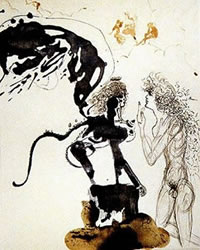
[Picture: OEdipus by Salvador Dali]
Wo Es War sollt Ich werde
Where it was shall I become
Sigmund Freud
It = chaos, unconscious, problem, symptom...
I = grammatically the first singular person, pro-nom personal...
There is a sine equa non condition to benefit from Psychology:
The person who wants to benefit from psychology must show a real commitment to work out the truth and, therefore, a willingness to examine one's own subjectivity in order to reach to the roots of any symptom, problem or conflict, aiming to solve it.
This condition implies that the first step would be to formulate the problem and to find out if there is room for treatment, in the mathematical sense of the expression. For the key to solve any problem is to be found in undoing its enigma and deconstruct whatever elements were beyond one's control, thus causing troubles in body and the mind, blocking one's own resources or hindering one's creativity, etc.
Having outline these factors, you may realize why true psychological
discipline encounters irrational resistance. Humans are not keen
to examining one's heart, let alone the dark side of it. For it does not flatter
the ego to find an unconscious at work behind the scenes and to have to
take responsibility in order to govern henceforth its forces creatively.
However, such is the road to personal fulfillment. To take the
path to understanding is the way forward if one desires to get really
rid of any symptom, illness or pathological situation.
Yet rather than wasting our life in blinding oneself, it would be wise to care knowing one's own heart. Afterwards, nobody escapes from the Delphic oracle: only truth can set us free.
That is why the great teachers of humanity (Socrates,
Siddharta,
Jesus,
Muhammad,
etc) had invited their disciples to carefully examining
their hearts, this through the words escaping by the mouth and thus revealing
the unknown, dark side of one's heart. Jesus of Nazareth, for instance (Mt.
XV 16-20), followed therein the Socratic method of getting rid of problems
by discovering the real reason of any suffering, even
without our conscious will.
A method always valid when dealing with human
beings, which Aristotle
encapsulated in this memorable definition: "An education which is
not examination of one's heart is not at all a true one".
This heart at work in human matters is what after Freud we call the unconscious.
In other words, to discover the light of the spirit, and to set its resources in action, a 'good conscience' does not suffice. For as the proverb says: good intentions pave the road to hell. It is therefore worth taking care of going beyond the veil and masks of the mere obvious and, with ethical courage (that classical Greece called Parrhesia (παρρησία), to examine one's point of view towards oneself and towards others; to set in motion the creative change so long desired.
Briefly (right in opposition to fashionable sycophantic credo or psycho-idiotlogies
of brain-programming-behaviors), true Psychology will ever signify: intellection
of the soul or intellectio veritatis.
In order words: it is the Socratic, maieutic discipline
wherein the cure or the resolution of symptoms is (beyond past frustrations) to understand
as gymnastics of the soul's faculties - above all the faculty of intelligence
- in order to create one's own well being.