Menu :
Links :
Time in London:
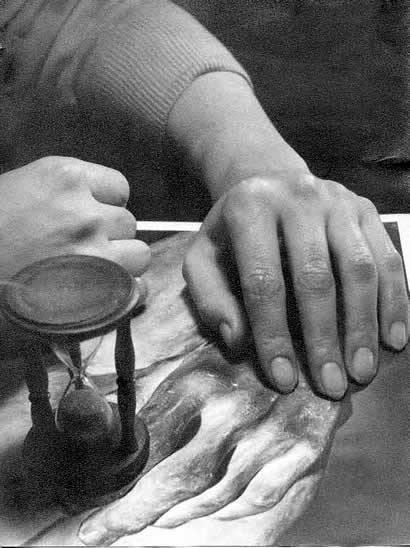
[Foto: Las manos de Betina Edelberg fotografía de Ricardo Aronovich.
“Las manos son la historia del tiempo. Las quiero porque me perniten escribir, y eso es una manera de ser todavía primitivos: algo así como alfareros, hilanderos o labradores. ¡Cuidado con las manos, tienen memoria!" B. E.]
(Ediciones Botella al Mar , 1948 )
(Ediciones Botella al Mar, 1951 )
Faja de Honor de la Sociedad Argentina de Escritores, 1951
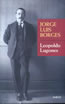
(Ed. Troquel, 1956). En colaboración con
Jorge Luis Borges
(Ed. Emecé, 1998). Se agrega a la edición original un nuevo
prólogo de Betina Edelberg: ”Volver a Lugones”(Octubre
1997)
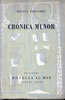
(Ed. Botella al Mar, 1956)
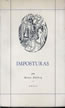
(Ed. Emecé, 1960) Mención Premio
Municipal de Literatura
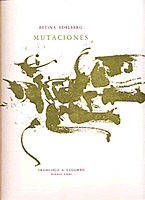 Mutaciones
Edición para bibliófilos en papel
Perusia Fabriano, numerada de I a XX; con el auspicio del Fondo Nacional
de las Artes
Con ilustraciones de Juan Carlos Benítez (Ed. Francisco Colombo,
1964 ).
Expuesto en E.E.U.U., México, Brasil (1965/66), enviado por el
Ministerio de Relaciones Exteriores (Relaciones Culturales).
Posteriormente expuesto por la Embajada Argentina en Francia; Casa Argentina
(Paris) y luego en Brasil.

Edición corriente, de 1000 ejemplares,
realizada sobre la caja de la edición para bibliófilos.
(Ed. Francisco Colombo, 1964 ); con el auspicio del Fondo Nacional de
las Artes
Texto de Betina Edelberg,
Texto de Betina Edelberg, grabados de Nicolás Rubió, basado en la exposición del artista realizada en la Galería Witcomb. (Plaquette, fuera de comercio, impresa en la imprenta Del Socorro, Agosto de 1967).
*
Antología Imperfecta del Humor Poético* Se incluyen trece de los “Animosos” de Jorge Luis Borges, hasta entonces inéditos.
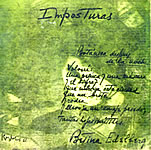
versión discográfica de un programa
radial emitido por Radio Nacional (1967)
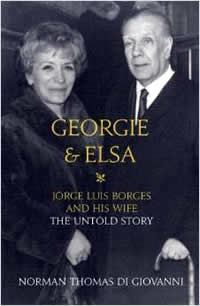 'Georgie
& Elsa' The Untold Story of Jorge Luis Borges and His Wife'
'Georgie
& Elsa' The Untold Story of Jorge Luis Borges and His Wife'
by Norman
Thomas Di Giovanni
“A biography of Borges, by his translator.
Jorge Luis Borges, known as Georgie to his friends, married Elsa Astete Millán in 1967. Borges was sixty-eight years old at the time of the wedding; Elsa, a widow, with a son in his twenties, was eleven years younger.
It proved to be a tempestuous and eventful marriage that would leave an indelible mark on the remainder of Borges’ life, but their relationship has been largely glossed over by previous biographers. This is because the one person who knew all the details has refused to speak about it. Until now.
Norman Thomas di Giovanni worked with Borges in Cambridge, Massachusetts, and in Buenos Aires from late 1967 to 1972 and thereafter sporadically until Borges’s death in 1986. During their first period together di Giovanni spent more time with the couple than did almost anyone else. He was privy to the private side of their relationship and to its sudden decline. It was di Giovanni who helped the demoralized Borges by organizing and arranging his divorce and at the same time rescuing his library and smuggling him out of Buenos Aires to avoid the wrath of Elsa and her lawyers.
The book is based on the author’s extensive collection of original material in the form of diaries, notebooks, letters, manuscripts, and photographs, most of which has never before been seen. It provides a unique insight into one of the few true geniuses of literature..."
Borges did not have sexual relation with any woman and was terrified by Elsa's tyranny... Borges beg his beloved young master Adolfito Bioy Casares, and their friend the philosopher and film maker Hugo Santiago, and his friend and translator Prof. Di Giovanni to free him from the sadic tyranny of Elsa Astete.
The roman familiar of the neurotic repeating its unconscious pattern -the Mother of Georgie was authoritarian, very domineering on her unique boy making of him the easy target of similar sadistic females (as indicated in autobiographic stories of the author) -, a decade later Borges would have to beg for help to free himself from the false widow Kodama... but none of his old friends around to help
Read more:
Jorge Luis Borges and his ‘bitch’ ... [The Spectator]
‘Georgie & Elsa: Jorge Luis Borges and His Wife, the Untold Story’ review in The Washington Post
Mr and Mrs Borges ...[The Times Literary Supplement]